Wandering Through the Soul of Boudhanath: Where Every Step Feels Like a Prayer
Have you ever walked somewhere that quietly changed you? Boudhanath Stupa in Nepal isn’t just a place to see—it’s a living rhythm of prayer flags, spinning wheels, and slow, mindful steps. I wandered here with no plan, and found something deeper: a heartbeat in the chaos, a calm that sticks with you. This is not tourism—it’s presence. And it’s absolutely real. More than a monument, Boudhanath is a living sanctuary where devotion moves with every footfall, where the air hums with whispered mantras, and where time seems to soften beneath the gaze of the all-seeing eyes painted high on the stupa’s golden spire. For travelers seeking not just sights but stillness, this is a destination that doesn’t merely impress—it transforms.
Arrival: First Impressions of Boudhanath
Emerging from the clamor of Kathmandu’s traffic—honking rickshaws, swerving motorbikes, the dust-laden breeze—one turns a corner and suddenly, the world changes. There it rises: the grand dome of Boudhanath Stupa, a massive white hemisphere crowned with a golden spire that catches the Himalayan light like a beacon. The transition is immediate. The noise doesn’t vanish, but it shifts—less frantic, more layered. The steady murmur of mantras blends with the rhythmic clink of butter lamps being lit, the soft rustle of prayer flags fluttering in the wind, and the occasional chime of a distant temple bell. The air carries a scent both earthy and sacred: incense, roasted corn from roadside vendors, and the faint smokiness of juniper burned in small copper bowls.
Boudhanath is one of the largest stupas in Nepal and a cornerstone of Tibetan Buddhist life outside Tibet. Built over a thousand years ago, it stands as both a religious monument and a community heart. For Tibetan exiles, Nepali Buddhists, and pilgrims from across Asia, it is a spiritual anchor. Yet its power is not locked behind ritual or language. Even without understanding the chants or the symbolism, visitors feel the weight of reverence that permeates the space. The stupa’s design itself speaks: the white dome representing the earth, the golden spire symbolizing enlightenment, and the painted eyes on all four sides gazing outward in compassion, seeing all without judgment.
This is not a museum piece. It is alive. The moment you step onto the wide stone path that circles the stupa, you become part of its rhythm. The contrast with Kathmandu’s bustling streets could not be sharper. Here, movement is measured, intention deliberate. People walk slowly, hands turning prayer wheels or fingers gently spinning handheld malas. The atmosphere invites you to shed urgency, to breathe deeper, to notice. It’s not about arriving—it’s about arriving within yourself.
Walking the Circumambulation Path: Movement as Meditation
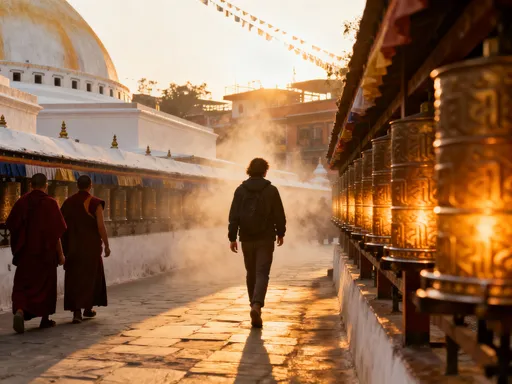
The heart of Boudhanath is the kora—the clockwise circumambulation path that circles the stupa. To walk this path is not sightseeing; it is participation. Pilgrims, monks, locals, and travelers alike move together in a quiet, flowing current. Each step is an act of devotion, each revolution a silent offering. There is no rush. No one checks a watch. The pace is that of breath, of thought, of intention made physical. As you join the circle, something subtle shifts. The mind, so often racing ahead, begins to settle into the present. The simple act of walking—left, right, left, right—becomes a meditation in motion.
Many walk barefoot, their feet tracing the cool, worn stones. Others spin the heavy brass prayer wheels set into the outer wall, each turn believed to release the mantras inscribed within. The tactile rhythm—hand on metal, wheel turning, the soft click as it resets—becomes a kind of prayer in itself. The stupa rises beside you as you walk, its tiers ascending like steps toward the sky. The painted eyes follow you, serene and knowing, reminding you that every action, even a single step, carries meaning. Above them, the golden spire points upward, a symbol of the path to enlightenment.
Regulars come daily—elders in woolen shawls, monks in maroon robes, women balancing baskets on their hips. They move with a quiet discipline, their devotion not performative but habitual, like breathing. There is dignity in their repetition, a deep-rooted connection to something greater. For the visitor, walking beside them is an invitation to slow down, to let go of the tourist’s checklist, and instead embrace the possibility of presence. You begin to understand that in this place, movement is not about covering ground but about grounding oneself. The kora is not a loop—it is a spiral inward.
Faces of the Path: People Who Bring the Place to Life
Boudhanath is not defined by stone and gold alone. It is animated by the people who walk its path, tend its shrines, and live in its shadow. A monk in deep maroon robes sits cross-legged beneath an awning, softly chanting into a handheld recorder, his voice steady and low. Nearby, an elderly woman with weathered hands and a face lined by decades of mountain sun turns prayer wheels with deliberate care, her lips moving in silent repetition. A shopkeeper offers a smile and a stick of sandalwood incense without a word, placing it gently into a visitor’s palm. These moments are not staged; they are lived.
The community here is a blend of Nepali locals, Tibetan exiles, and Buddhist practitioners from around the world. Many fled Tibet decades ago and found refuge in this neighborhood, turning Boudhanath into a cultural and spiritual hub. Their presence gives the site authenticity—a sense that this is not a performance for tourists but a way of life. Children run between prayer wheels, laughing, while their grandparents bow before small shrines. Monks gather in courtyards, debating scripture or preparing for rituals. Pilgrims from Bhutan, Mongolia, and India arrive with offerings, their faces lit with quiet reverence.
As a visitor, the invitation is not to intrude but to observe, to witness with humility. There is no need to understand every gesture or chant to feel their weight. A woman prostrating fully on the stone path, rising slowly, bowing again—this is devotion in its purest form. A man lighting a butter lamp, whispering a prayer for a sick relative—this is faith made visible. These acts are not meant to impress; they are simply part of the daily rhythm. To walk among them is to be reminded that spirituality is not always loud or dramatic. Sometimes, it is a whisper, a turn of the wheel, a single candle glowing in the dusk.
Sounds and Scents: The Unseen Layers of the Experience
Boudhanath engages more than the eyes. It is a place felt through the skin, breathed in through the nose, heard in the bones. Close your eyes, and the atmosphere reveals itself in layers. The air is warm with the scent of burning juniper, a fragrant wood believed to purify space. It mingles with the rich aroma of butter tea simmering in clay pots, the sweetness of roasting corn from street vendors, and the musky depth of old incense clinging to temple walls. These smells are not incidental—they are part of the sacred environment, designed to awaken the senses and quiet the mind.
The soundscape is equally rich. From small shops tucked into the stupa’s base, recordings of monks chanting the Om Mani Padme Hum mantra spill into the air, looping gently like a sonic tapestry. Bells chime with each turn of a prayer wheel. The soft clatter of butter lamps being lit, the rustle of prayer flags flapping in the wind, the low murmur of conversation in Tibetan, Nepali, and Hindi—all form a quiet symphony. Even the occasional honk from the nearby road feels absorbed, softened by the stillness that hangs over the site.
These sensory details are not background noise. They are integral to the experience, shaping mood and memory. The scent of incense can trigger a wave of calm days later. The sound of a bell can recall a moment of clarity. This is the power of embodied travel—when a place lives not just in photographs but in the body’s memory. At Boudhanath, the unseen layers are what linger. They teach you that presence is not just mental but physical. To be here is to feel the warmth of the sun on your shoulders, the coolness of the stone beneath your feet, the breath moving in and out as you walk—each sensation a thread in the fabric of awareness.
Hidden Corners: Quiet Spots Just Off the Main Path
While the stupa draws the crowds, its magic also lies in the quiet spaces just beyond the main path. A short climb up a narrow staircase leads to a rooftop café where you can sit with a cup of milk tea and watch the kora unfold below. The view is panoramic—the stupa’s golden spire catching the late afternoon light, pilgrims moving like slow water around its base. From here, the chaos of Kathmandu fades, and the rhythm of devotion becomes even clearer.
Nearby, small temples and meditation halls offer stillness. Some are tucked into alleyways, marked only by a faded sign or a row of butter lamps. These spaces are not designed for tourists but for practice. A sign might read “Meditation in Progress—Please Enter Quietly.” Inside, cushions line the floor, a statue of Buddha rests at the front, and the air is thick with silence. Sitting here, even for ten minutes, can be a reset—a return to center.
Another hidden gem is the upper level of the stupa complex, where fewer visitors climb. Here, the view is intimate. You can see the intricate carvings on the spire, the way the prayer flags are tied in careful knots, the small offerings left in niches—flowers, rice, coins. It’s a place for reflection, for slowing down even further. One might bring a journal, a camera, or nothing at all. The act of pausing, of simply being, becomes the purpose. These corners remind us that travel is not only about grand sights but about finding space to absorb them. In a world that values speed, Boudhanath’s quiet spots teach the radical act of stillness.
Practical Insights: When to Go, What to Respect
To fully experience Boudhanath, timing and awareness matter. Early morning is ideal—between 5:30 and 7:30 a.m., the air is cool, the light soft, and the path is least crowded. This is when monks chant in unison, their voices rising in harmony with the dawn. The atmosphere is deeply peaceful, perfect for walking with intention. Late afternoons, especially around sunset, are also beautiful, though more crowded. If you visit during a festival—such as Losar (Tibetan New Year) or Buddha Jayanti—expect vibrant energy, prayer flags at full flutter, and special rituals. But also expect larger crowds and limited space.
Dress respectfully. Shoulders and knees should be covered as a sign of reverence. While the site welcomes all, modest clothing shows cultural sensitivity. Avoid loud conversations, loud music, or disruptive behavior. Photography is generally permitted, but always ask before photographing people, especially monks or those in prayer. Never step in front of someone prostrating or block their path. Turn prayer wheels with your right hand, moving clockwise, as tradition dictates.
A guide is not necessary for a meaningful visit. The beauty of Boudhanath lies in wandering without agenda. However, if you seek deeper understanding, small informational centers nearby offer brochures or short talks on the stupa’s history and symbolism. The best approach, though, is to come with openness. Observe. Listen. Walk. Let the place speak to you in its own way. Respect is not about knowing every rule but about moving with care and humility.
Why This Kind of Travel Matters
In an age of fast travel—of ticking off bucket lists, chasing photo ops, and racing from one destination to the next—Boudhanath offers a different philosophy. It asks not what you can collect, but what you can release. It invites you not to conquer a place, but to be present within it. Here, the goal is not distance covered but depth experienced. The kora is not a race; it is a return—to breath, to body, to awareness.
This kind of travel matters because it reconnects us to what is essential. In the quiet rhythm of walking, in the scent of incense, in the sight of hands turning prayer wheels with devotion, we remember that life is not only about doing but about being. We are reminded that stillness can be powerful, that repetition can be sacred, that presence is a gift.
Boudhanath does not demand belief. It simply offers a space where the soul can breathe. For the 30- to 55-year-old woman—often balancing family, work, and endless responsibilities—this kind of journey can be especially transformative. It is not escape, but reconnection. It is a chance to step off the treadmill, to walk slowly, to feel the sun, to hear the bells, to remember that she, too, is part of something larger.
And perhaps the greatest lesson of Boudhanath is this: you do not need to travel to Nepal to walk a kora. The principle is portable. Every day offers its own quiet revolutions—moments to pause, to breathe, to turn inward. Whether in a garden, on a city sidewalk, or in a quiet corner of the home, the practice of mindful walking, of presence, of reverence for the ordinary, can become its own pilgrimage. Boudhanath shows us that the sacred is not always far away. Sometimes, it is just a step—and a breath—away.